Hjem Toylander
Toylander
Toylander II PDF Print E-mail
Written by Tore Ørpetveit   
Sunday, 24 February 2008 10:35

Toylander

As a child, I had a kiddie car. It was made by my father, using scooter wheels. With safety belts and the rear lights from a Volvo Amazon it truly was envied by every other boy in the street. It was constantly improved and upgrades - at some time it even got brakes.

That kiddie car is one of my fondest memories. Today, I've got 3 crazy boys of my own. It's my turn making them a kiddie car.

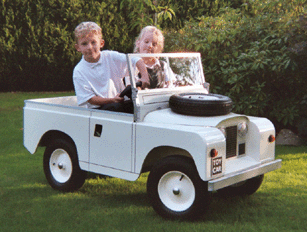
A few years ago, i happend to see the picture to the right on a website somewhere. It's a Land Rover. A small Land Rover. Some research showed it to be a Toylander. A gentleman in England makes a living from selling blueprints and more or less prefabricated parts for it. I ordered blueprints, and a few weeks later building could start.
Last Updated on Wednesday, 17 September 2008 19:34
 
The Body PDF Print E-mail
Written by Tore Ørpetveit   
Sunday, 02 March 2008 12:44
Body parts

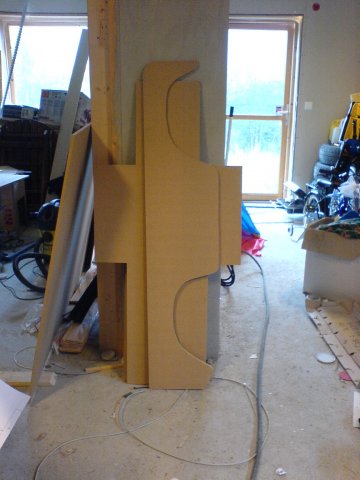
After receiving the plans, building could commence. The suggested way of doing this, is to glue the patterns to the MDF, and cut along the lines. I found this to be a tad brutal to the pattens, and chose to glue them to some carton and cut along the lines. This way, I had a set of relative strong templates I could use to mark where to cut. It is possible to make minor adjustments before cutting, and if I ever need to make spare parts (or another car), The templates will come in handy.

A land Rover Series II is built on a frame, with a body made from aluminum and steel bolted on top of it. A Toylander II is built from moisture resistant MDF or plywood as a unibody. I initially wondered whether to use MDF or plywood. Both materials have approximately the same weight and cost, plywood is probably somewhat stronger. MDF on the other hand is easier to work on, and will give a smooth finish with less work. I chose MDF.
Building started

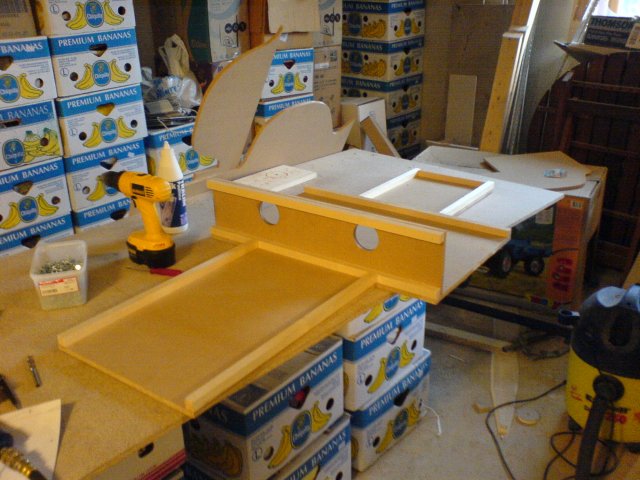
It takes a bit more than one sheet à 120x240cm of MDF or plywood to make one car. (I guess you can make 3 cars from 4 sheets). To cut the parts takes a few evenings. The parts are glued and screwed together using 19x19mm battens. I was surprised to see how well the part fit, and the body tub has a construction that makes it very solid and rigid.

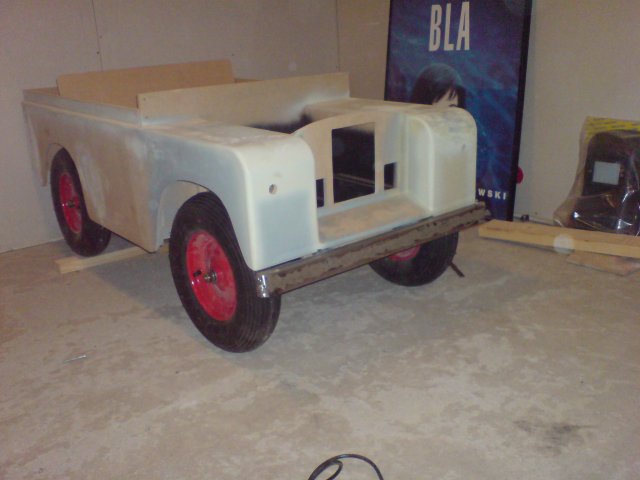
When building the body tub, I mostly followed the directions given. Some minor adjustments was made, like using model plywood, not aluminum, for the curved part of the front panels, and to make the seat back removable to allow grown-ups to drive the car.
Last Updated on Wednesday, 17 September 2008 19:43
 
Wheels PDF Print E-mail
Written by Tore Ørpetveit   
Saturday, 08 March 2008 08:35
Wheels

A kiddie car without wheels is no fun. Getting a set of suitable wheels turned out to be a challenge. The wheels needed should have a diameter of approximately 40cm, and 8"x2-2,5" rims. As the car is relatively heavy, they need proper ball or needle bearings. Bushings would wear too fast.

The company/person selling patterns for the Toylander - Real Life Toys - is also supplying all sorts of parts, including wheels. The parts are reasonably priced, and I strongly considered buying from him. However, shipping was an issue. Royal Mail wanted a lot to roll a set of wheels over the North Sea. In fact, it would have taken the entire kiddie car budget. I had to find an alternative.

At work we have a yellow trolley. It's wheels are perfect! No, I did not steal the wheels from the trolley - that would have been just a tad too obvious. However, the trolley had Trallnor written on it. With a little help from Google, I found that they were located just a few fields from work. One day - during lunch - I visited them. After a tour of the factory, we reached the wheel storage room. They had a huge variety of wheels, but none had offroad patterns. I ended up buying a set of heavy duty wheel barrow wheels. They had ball bearings and solid steel rims. Hopefully, Ill get a set of offroad tires at a later stage.
Last Updated on Saturday, 08 March 2008 09:20
 
Suspension and steering PDF Print E-mail
Written by Tore Ørpetveit   
Saturday, 08 March 2008 09:20
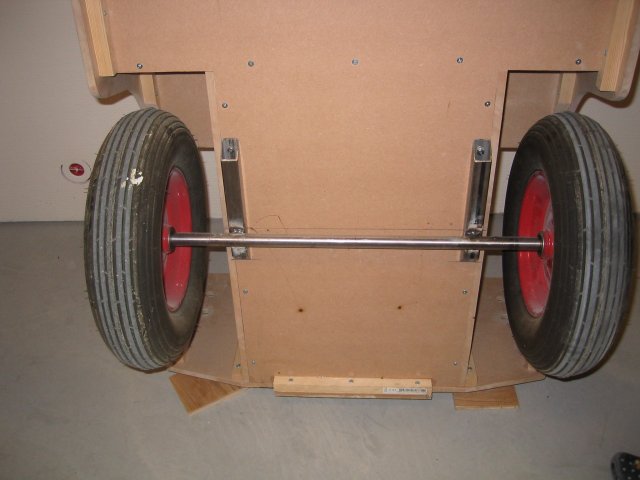
Rear Axle

The build manual has plans for the axles and suspension. These are easy to build - rigid rear axle and a front axle like the ones found on trolleys. It also has a suggestion and sketches for a front axle with suspension.

A long time ago, I used to have a genuine interrest in cars and motors. To be honest, I found the setup to be just too simple. I had to improvise. The wheels I had got had bearings for 18mm axles. Instead of using 25mm pipes for axles, I used an 20mm stainless steel axle which I cut down to 18mm for the bearings. At the ends, I made M16 threads. Center nuts are how wheels are secured in Formula 1 - the Toylander can have no less.

At the rear, I increased the track by 50mm and lowered the suspension by 25mm compared to the instructions. A Land Rover has a lot of ground clearance and a narrow track. This is favourable for driving along English sheep trails, but the Toylander is not intended for offroad use. At least not intentionally. My priority is on handling and stability on road.
Front suspension

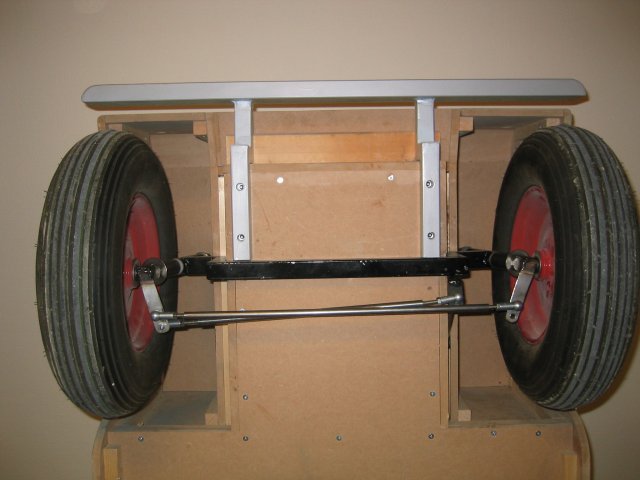
At the front, a lot more improvements could be done. The front suspension described in the plans is intended to be rugged and easy to build. And it is. My wish was to build a front suspension giving better road handling, beeing just as strong and still reasonably easy to build. I used suggested sketches for "suspension steering" as a start.
Front axle

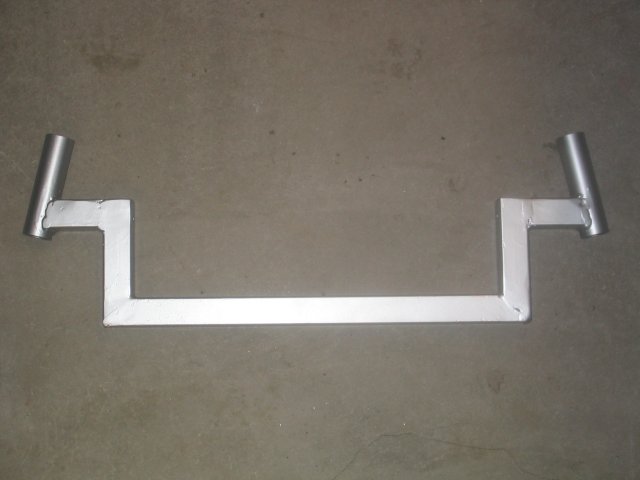
The first adjustment I made to the design, was to incline the sliding pillars to achieve a positive King Pin Inclination. This makes the front wheels turn about a point in the center of the tyre. Additionally, the steering will be self-centering. That's a good thing.

Next thing I changed was the angle of the steering arms. When these are in parallell, both front wheels will turn the same angle when you turn the steering wheel. However, when a car is driving around in a circle, the distance from the center of the circle to each front wheel is different. Thus, the angle each wheel is turned relative to the car, should be different. This is described by the Ackermann's principle.

The front track is increased by 2" and the car lowered 1" like at the back.

Today, the steering is similar to the ones found in gocarts. There is an arm attached directly to the steering column. This means there is half a turn on the steering wheel from full left to full right. That is OK for a gocart, but it is not particularly Land Rover-ish. I'd like it to take at least two full turns of the steering wheel from full left to full right. This is not a priority, though. It'll have to wait until a suitable steering rack shows up.

Last Updated on Sunday, 06 September 2009 09:53
 
Painting PDF Print E-mail
Written by Tore Ørpetveit   
Saturday, 06 September 2008 06:04

What colour to chose? This is the single most debated question in this build. The builder (me) wanted a genuine Land Rover colour. The future users (the kids) wanted something like pink or orange. We ended up more or less agreeing on RAL3000 - flame red.

Land Rovers have been used as fire trucks in British villages since the dawn of day. A picture of such a truck made us agree. The British Series 2 club have a huge gallery of Land Rover Series 2 vehicles. If you are building a Toylander, this is splendid for looking up details to model.

Primer

Every paint job starts with the prep work. As the car is built of MDF, the surfaces are initially quite smooth. If I had built the car from plywood, it would have been necessary to use a lot of filler to get smooth surfaces. MDF only needed a light treatment with 400-grid dry sanding paper. Then all joints and damages where filled with putty and sanded.

The local paint shop recommended using Lesonal 2K Filler as primer and filler. I used a "professional" spray gun with a 1,9mm nozzle from Clas Ohlson. The filler was drying quickly, and I could apply 3-4 layers in one operation. When the filler had dried completely, some minor damage and "unevenness" was visible, and I fixed these with putty. After sanding, an additional layer of filler was applied. I then sanded the entire body with 800-grid wet sanding paper.

Ready for paint

The paint I used was something called "Transport paint". It's a 2k polyurethan based paint used for lorrys etc. Very strong, easy to spray and cheaper than car paint. It does not get as glossy as car paint, though, and it cures slower.

Painted

The day I got around to paint the Toylander was a cold one. Too cold for painting, really. I had no chance getting the paint to "float" without applying too much. As a result, it got an "orange peel" texture on the surface. I will have to sand it lightly with 1200-grid sanding paper and polish it to get that nice, glossy surface the kids will ruin on the first trip.

This Toylander is supposed to become a fire truck. It needs fire truck stripes, like the good old fire trucks had. My first plan was to mask and paint all the squares. Luckily, I got a better idea. There are people making car decor for advertising etc. I just ordered the stripes - and got a bargain.

Last Updated on Saturday, 25 October 2008 15:31
 
Power Train PDF Print E-mail
Written by Tore Ørpetveit   
Saturday, 25 October 2008 15:33

As the car entered a pushable state, we've had a few runs up and down the street. The kids have been driving, and I've been the motor. The Toylander is heavy. With some speed and the driver suddenly deciding to change direction, running behind pushing has proved itself rather dangerous. The Toylander needs a motor.

RLT sell motors from UK based EMD. The model they have chosen is a 12V 180W unit. It is used in many other applications, and it is considered durable and withstand serious overload without damage. At 115 pounds per unit they are probably reasonable priced, but I decided to look for alternatives...

I lost a few auctions on eBay before winning two "NOS" (New Old Stock) wheelchair motors for $30. They are 24V units, rated at 360W continuous power. Wheelchair motors are heavy items, and freight to Norway was more than the purchase price... Anyway, I got two motors for half the price of an original motor.

The motor output shafts do 284 revolutions per minute at full speed. My wheels have a circumference of about 125cm. Without gearing, that would give the car a speed of 35m/min, or 21km/h. That is too fast. The power from the motors is delivered to the wheels via chains. I put sprockets with 30 teeth on the output shafts of the motors, and 65 teeth on the wheels. This translates to a theoretical top speed of 9 km/h. Driving the car, we have seen that the real life speed is very close to the theoretical.

Motorer

To power the motors, I got two 12V 30Ah SMF batteries from Biltema. Having previous experience with speed controllers from UK based 4QD, I chose a VTX-75 controller for the Toylander. The VTX is a fairly simple controller, it is not programmable but the acceleration and retardation "ramps" can be adjusted. It also has optional "half speed reverse", can take a feedback signal to operate in "closed loop" and most importantly - regenerative braking.

In my opinion, regenerative braking on a toy vehicle is a (nearly) mandatory safety feature. It makes the car much easier to control for minor children. Push the throttle to go, release to stop. The "one pedal to go, another to stop" concept can be to complicated for a 3 year old, especially in an emergency.

Last Updated on Sunday, 06 September 2009 08:22
 
Detailing PDF Print E-mail
Written by Tore Ørpetveit   
Saturday, 25 October 2008 15:39
Having finished most of the work on the body and suspension, I am finally able to start on the real fun - all the detailing. What sets a really good looking model from a plain one is the details. I have no intention of making the most realistic Land Rover model around, the car is intended as a toy for a bunch of wild kids. But I can't help myself from trying.
 
Speedometer and odometer PDF Print E-mail
Written by Tore Ørpetveit   
Friday, 01 May 2009 13:01

From the very beginning, I had intended to put a speedometer and a battery meter in the Toylander. There was no way the kids would have accepted a sticker as the dash board. Battery meters for 24V are plentyful, and I got one from eBay. A speedometer is harder to come by.

My original plan was to tap into the signal from the tacho generator on one of the motors, and connect it to a voltmeter disguised as a speedometer in the dash. There is a lot of 2" instruments available that are really only voltmeters and some circuitry to translate from whatever signal they are measuring.

For some reason, however, I have found myself in a friendly competition with Joakim, the other Toylander owner in the district. It seems we are competing to see who will be driving his Toylander the longest total distance during the summer. This means I need an odometer in addition to the speedometer. That's a lot harder to make.

The easy solution is a bicycle computer. They show current speed, distance covered today, total distance and more. Problem is, a digital speedometer would be very far from authentic on a model of a 1958 Land Rover. One solution is of course to hide the bicycle computer in the battery compartment and only use it to document distance covered.

Sigma500

After a lot of thought, I decided to place the digital speedo in the dash, and don't care about it not beeing authentic. I bought a relatively cheap and simple Sigma 500 bicycle computer, and a 2" amperemeter. The amperemeter was the cheapest 2" instrument I could get, and as I only wanted the housing, I removed it's guts with a dremel.

Sigma

The bicycle computer has one single button to cycle between distance today, total distance, time etc. I wanted this function to be available even after I had the computer mounted in a 2" housing. This meant I had to connect an external button to the PCB inside the computer. The Sigma is not inteded to be opened, I had to cut away parts of the housing with the Dremel to get access.

Dashboard

To fit the bicycle computer inside the amperemeter housing, I made a Ø50mm disc from acrylic glass. In this, I cut an opening the same shape and size as the Sigma's display, and painted it black. The Sigma was then hot-glued to the back of this disc, and the entire unit was secured inside the housing.

Last Updated on Sunday, 03 May 2009 11:52
 
Toylander på nett PDF Print E-mail
Written by Tore Ørpetveit   
Sunday, 10 May 2009 10:23

Det dukker stadig opp nye nettsteder av og for Toylanderbyggere og -eiere. Real Life Toys har startet et engelskspråklig forum på http://www.toylanderownersclub.com. Der er det allerde ganske god gang på diskusjoner og byggeblogger.

Her hjemme har noen ildsjeler satt i gang et liknende norskspråklig prosjekt. På http://www.toylanderforum.no/ finner du artikler om livet som Toylandereier og -bygger.

Last Updated on Saturday, 16 May 2009 17:10
 
Steering part 2 PDF Print E-mail
Written by Tore   
Sunday, 06 September 2009 10:00

As mentioned above, I am not completely happy with the connection between the steering wheel and the wheels. Using an arm welded directly to the steering axle results in a very direct and somewhat heavy steering. As a result, the kids find it a bit problematic doing precision maneuvering.

The original solution has a number of obvious pros. It is cheap and easy to make. It is very robust, and will probably last the entire lifetime of the Toylander. When driving the car in an open place with enough space, it is doing a fine job. Even a 2 year old can drive the car. The problem arise when a kid tries to do precision maneuvering in a tight spot.

On the forum, this "problem" has been discussed, and several solutions has been put forth and tested. The ideal solution would be one that kept the simplicity and robustness of the original, but added a larger ratio and more precision.

Steering Rack

I've got my hands on a steering rack made for desert buggies. It's small and cute, only 8" from end to end. It has a tad more than one turn from lock to lock, and it will fit nicely between the steering arms on the Toylander. The challenge lies in connecting the rack to the steering axle.

I plan to place the rack with the axle pointing up into the battery compartment on the Toylander. On the axle, I will place a sprocket. The steering axle will get an universal joint and a sprocket, and I'll use a #25 chain to connect them. A double bottom in the battery compartment will hide the sprockets and chain. Being lucky, I might manage to complete this 'till the spring.

Last Updated on Sunday, 06 September 2009 10:24